
Start with the measurement, then choose the frequency span
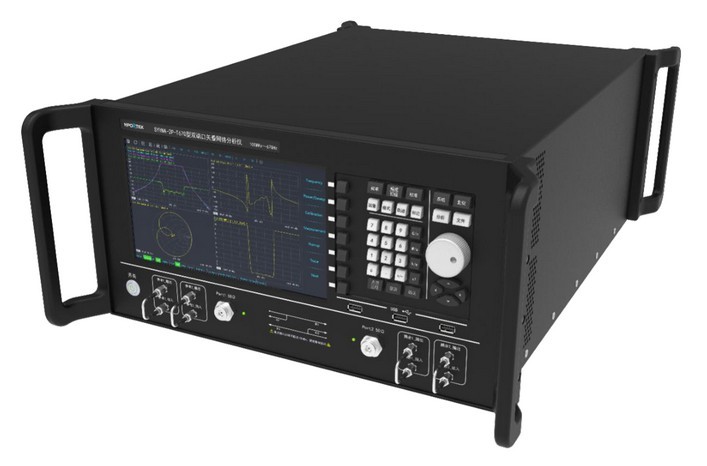
Write down the device under test, the required frequency span and the measurements you need before comparing instruments. A connector, filter, cable assembly or amplifier can impose different requirements. Include the lowest test frequency, the highest frequency, and any margin needed for characterization. The highest frequency alone is insufficient: the published HPORTEK SYVNA-2P-T67G range starts at 100 MHz and extends to 67 GHz, while the SYVNA-2P-T40G starts at 300 kHz and extends to 40 GHz. A 67 GHz instrument therefore does not automatically cover every lower-frequency task served by another model.
Match the number of ports to reflection and transmission tests
A single-port VNA can support reflection measurements such as return loss, VSWR and impedance. Transmission measurements require an appropriate multi-port measurement arrangement. Decide whether the workflow needs both forward and reverse S-parameters, how the DUT is connected, and whether fixture access is practical. The SYVNA-1P-20G-A is a single-port model with a published 10 MHz to 20 GHz span. The modular SYVNA-2P-M26.5G is a dual-port alternative spanning 100 MHz to 26.5 GHz. Confirm the available S-parameters, calibration functions and required accessories for the exact configuration before ordering.
Budget for calibration and the complete connection path
Treat the calibration kit, test cables, adapters, fixtures and connector condition as part of the measurement system. Select components for the complete frequency span and the relevant connector interfaces. Establish the reference planes at which results should apply, and decide how fixture effects will be handled. Inspect connector cleanliness and pin depth before making a connection; use the recommended torque for the specific connector. A calibration performed with an unsuitable adapter or a damaged cable cannot be rescued simply by selecting an instrument with a higher upper frequency.
Check dynamic range, output level and practical throughput
Compare the actual specifications and stated conditions for the DUT measurement rather than assuming that frequency coverage determines accuracy. Check source output level, receiver limits, dynamic range, IF bandwidth choices, sweep points and sweep time where those data are available. Ask for the conditions behind a typical value and distinguish them from a guaranteed limit. For low-loss or high-rejection devices, the useful measurement range can depend strongly on settings and the fixture. Request a demonstration using an agreed test configuration when a published table does not answer the selection question.
Choose a format and verify the automation interface
Bench-top, portable and modular formats suit different workflows. Consider available space, power, display requirements, cable movement and environmental conditions. For automated test, ask for the supported command interface, software documentation, connection method and example measurement sequence. The catalogue describes open interfaces on several HPORTEK VNA models, but interface availability should be confirmed for the selected hardware and software revision. Include calibration recall, result transfer, error handling and repeatability checks in the acceptance procedure rather than testing only a single successful sweep.
Prepare a selection request that engineering can evaluate
Send the DUT description, frequency limits, port count, required S-parameters, expected signal levels, connector types, automation needs and desired quantity. State which figures are mandatory and which are preferences. The public product pages and generated datasheets are starting points for comparison; they do not replace a configuration-specific quotation or operating instructions. For a 67 GHz setup, ask the team to confirm the instrument, cables, calibration accessories and fixture as one compatible measurement chain.
Related products
- SYVNA-1P-20G-A · Single-Port Vector Network Analyzer
- SYVNA-2P-M26.5G · Dual-Port Vector Network Analyzer
- SYVNA-2P-M40G · Dual-Port Vector Network Analyzer
- SYVNA-2P-T67G · Dual-Port Vector Network Analyzer
Engineering guidance for initial selection. Model-specific limits and configurations must be confirmed with HPORTEK. Calculation examples are illustrative and do not represent measured product results.
Download application note (PDF · English) ↓
Back to company updates