Signal Generators
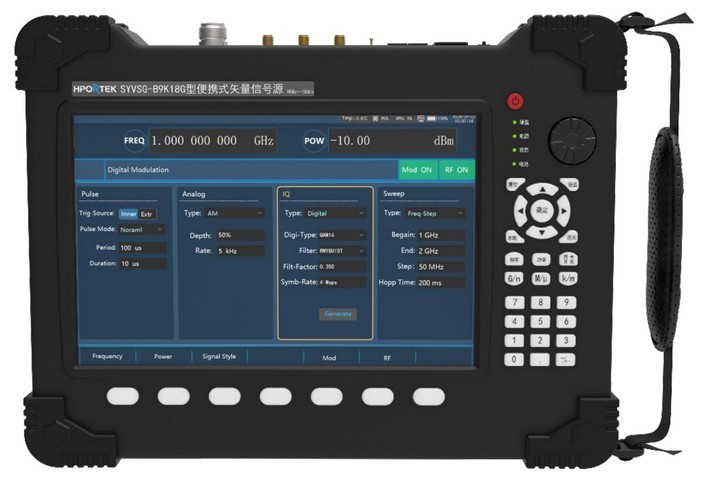
SYVSG-B9K18GPortable Vector Signal Generator
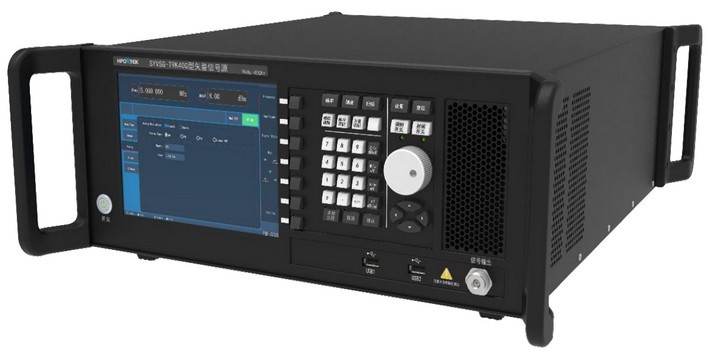
The SYVSG-B9K18G is a bench-top vector signal generator covering 9 kHz to 18 GHz for general lab use. It…
View product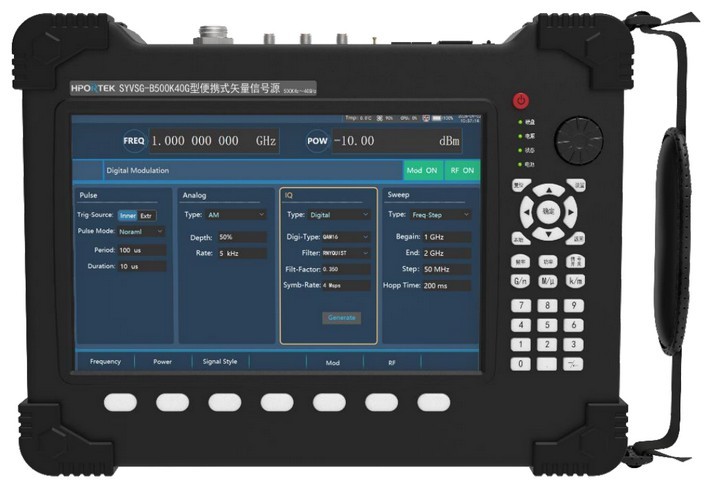
Signal Generators
The SYVSG-B500K40G is a portable vector signal generator covering 500 kHz to 40 GHz for field test. It supports FM, AM, CW, FMCW, QPSK, BPSK, 8PSK, QAM, as well as spot jamming, wideband noise, linear chirp, chirp noise, and comb spectrum. It supports external and battery power, with over 2 hours of battery operation.
TECHNICAL DATA
Specifications correspond to the product catalogue. Contact our technical team for configuration and operating conditions.
| Parameter | Specification / typical value |
|---|---|
| Functional Specifications | |
| I/Q data loading | Supported |
| Built-in self-test | Supported |
| Remote control | Supported |
| Graphical user interface | Supported |
| Logging | Supported |
| Sync output & external pulse modulation | Supported |
| Multiple modulations: AM, FM, PM, CW, ASK, PSK, FSK, QAM, etc. | Supported |
| Touchscreen & key control | Supported |
| AC adapter / battery powered | Supported |
| Technical Specifications | |
| Output Frequency | 500kHz~40GHz |
| Output Frequency Accuracy | ≤1ppm |
| Instantaneous Bandwidth | ≤600MHz |
| Output Power | -120dBm~+10dBm(500kHz~18GHz);-110dBm~ +5dBm(18GHz~40GHz) |
| Min. Output Power Step | 0.1dB |
| Power Accuracy | ±1.5dB (output power ≥-60dBm); ±0.5dB (output power ≥-40dBm) |
| Sweep Mode | Step sweep, list sweep, etc. |
| Output VSWR | ≤1.8 |
| Harmonics | ≤-40dBc (output power -20dBm) |
| Spurious | ≤-40dBc |
| Phase Noise | ≤-105dBc/Hz @ 10kHz (10GHz output) |
| General Specifications | |
| Dimensions (L×W×H) | 320 mm × 240 mm × 60 mm (excluding corner guards and handle) |
| Weight | ≤5 kg (including battery) |
| Battery Life | ≥2h |
| Operating Temperature | -10℃~+50℃ |
| Storage Temperature | -20℃~+70℃ |
Specifications are subject to change without notice. Contact our technical team for full conditions, interface definitions, and ordering information.
EXPLORE MORE
The SYVSG-B9K18G is a bench-top vector signal generator covering 9 kHz to 18 GHz for general lab use. It…
View productThe SYVSG-T9K40G is a bench-top vector signal generator covering 9 kHz to 40 GHz. It offers wide dynamic range,…
View productThe SYASG-B9K18G is a portable analog signal generator covering 9 kHz to 18 GHz for field test. It uses…
View productThe SYASG-B500K40G is a portable analog signal generator covering 500 kHz to 40 GHz for field test. It uses…
View productLET’S CONNECT
Talk to our team about your measurement, signal processing, and system integration requirements.